ESMART
Whitepaper
PUBLISHED SPEED SAFETY DATA
Non-overridable ISA cuts fatal crashes 49%
TRUCK-RELATED TRAFFIC INCIDENTS
The Role of Non-overridable Intelligent Speed Adaptation Systems in Reducing Traffic Incidents
According to the National Safety Council, there were over 42,000 reported fatal motor vehicle accidents in 2020, and the 2021 estimate is expected to be even higher at 46,000.1
Almost 30% of these fatalities were related to speeding,2 and large trucks (gross vehicle weight rating > 10,000 pounds) accounted for 9% of all fatal crashes.3 In addition to fatal accidents, it was estimated that more than 5.2 million accident victims necessitated medical attention in 2021.1
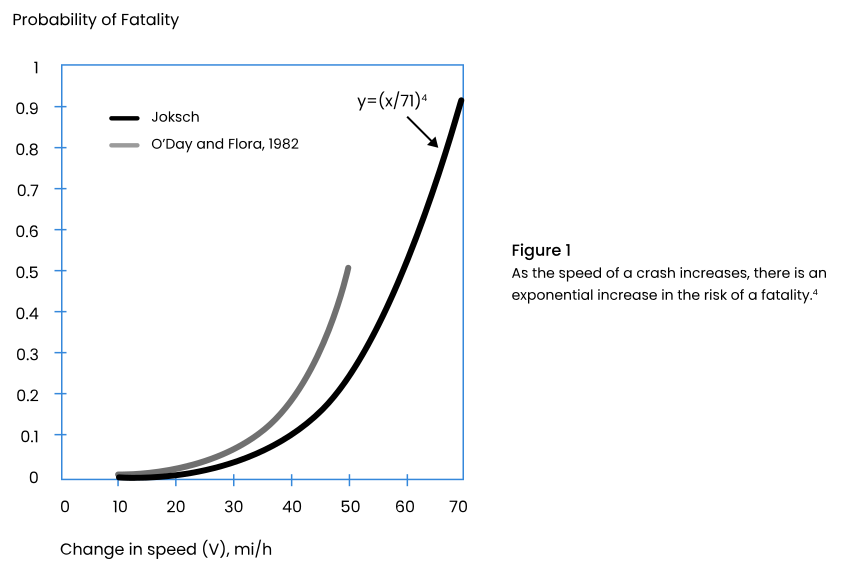
Many factors contribute to these accidents, but one of the major contributors is speeding.
More than 50% of drivers freely admit to exceeding the speed limit, often by more than 15 mph.5
In 2020, speeding was a factor in 29% of all traffic fatalities, representing a 3% increase compared with 2019, and bucking a several-year trend that saw a gradual decrease in speedingrelated deaths.2
Why is speeding such a major contributor? From a basic physics perspective, there is an exponential increase in the energy of a vehicle upon increasing its speed.6
This is why crashes involving speeding, even those at relatively slower speeds such as 40 mph, carry a 70% chance of fatality.7
Speeding also decreases the time and distance to respond to a dangerous situation, further increasing the risk of injury or death.8
Clearly, speeding is a major issue that needs to addressed, but unfortunately, drivers may not even realize they are speeding until after the fact. To help address this issue and eliminate human error, the Federal Motor Carrier Safety Administration has issued a notice of intent to impose regulations aimed at equipping large trucks with a speed limiter device that automatically,2 manages a vehicle’s top speed.9
Large vehicles such as trucks are the target of this legislation because they carry the heaviest loads; thus, a small increase in their speed will have a much greater effect on their force during an impact than for lighter vehicles.
Trucks can be equipped with a type of speed limiter called an intelligent speed adaptation (ISA) system, which automatically helps regulate a truck’s speed and operates in either a passive or active fashion. Passive advisory ISAs work by reminding the driver of the posted speed limit by providing visual or audio warnings when they exceed the speed limit. Active ISAs can be classified as either overridable (e.g., adaptive cruise control and automated emergency braking) or non-overridable (e.g., fixed or dynamic).
INTELLIGENT SPEED ASSISTANCE
Overridable intelligent speed adaptation (ISA) systems can be enabled and disabled by the driver,
allowing the driver to change the truck’s maximum speed. In contrast, non-overridable ISAs work by limiting the truck’s maximum speed and do not permit the driver to change the maximum speed settings. They can only be changed remotely by a fleet manager.
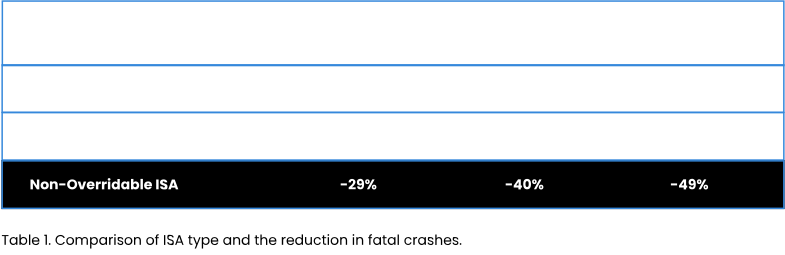
Although all types of ISAs have been shown to reduce the likelihood of incidents that result in an injury,10 non-overridable ISA systems provide a nearly 10-times greater reduction in accidents compared with advisory ISA systems (Table 1). A Non-overridable ISA system automatically limits a truck’s speed when the speed limit is exceeded.
How does it work?
Using advanced positioning technology, the system determines both the location of a truck in real-time and the posted speed limit at that location. The technology actively manages a truck’s speed and automatically limits the speed if it exceeds the posted speed limit (according to the fleet’s speed configuration). The system regularly receives updated maps and software, ensuring it is equipped with the latest, most accurate speed limits and road conditions. ISA technology allows for several features, including geofencing, which involves creating a virtual boundary for a real-world area that allows a custom speed limit to be set for each geofenced area. With the low-bridge collision prevention feature, the throttle is limited to idle speed when the vehicle is within 750 feet of a low-clearance bridge (13’ 5” or lower). When a truck is approaching a low-clearance bridge, an automated voice warning can be activated to alert the driver of their situation. Then, the accelerator is disabled, allowing the truck to coast to a stop. An ISA also allows for remote immobilization for either a stationary vehicle or one in motion—a useful feature in the case of theft or impaired driving.
Results
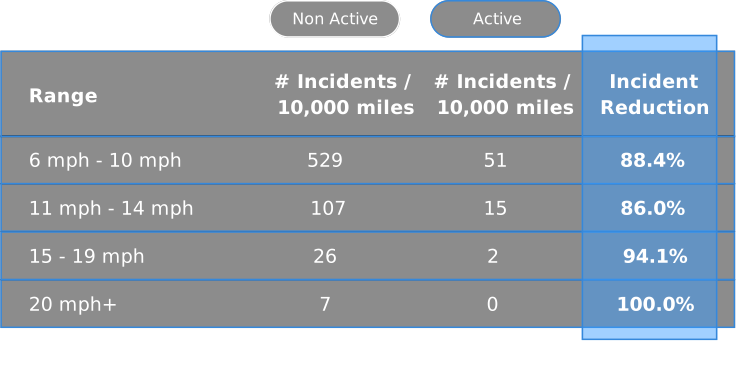
After over 2.25 billion miles driven of sampling by non-overridable ISA users in North America, the data show significant reductions in speeding-related accidents compared with nonactive ISA. As shown in the table in Figure 2, the use of a non-overridable ISA reduced the number of incidents compared with a non-active ISA, even resulting in a 100% reduction in incidents in which the vehicle exceeded the speed limit by more than 20 mph.
INTELLIGENT SPEED ASSISTANCE
During a 3-year test of a full-fleet deployment of 3000+ trucks, there was a 50% reduction in speeding-related incidents and a 53% reduction in the severity of accidents.
As a result, this can also help eliminate speeding violations and improve CSA scores by automatically regulating a truck’s speed.
Potential Impacts on the Trucking Industry of low-bridge collision prevention
The National Highway Traffic Safety Administration has estimates that bridges in the US are struck an average of 15,000 times per year,11 and past estimates have indicated that as many as 14% of these strikes occur due to trucks.12 Bridge strikes can result in enormous economic consequences, both for the truck owner and carrier, as well as the wider economy due to traffic disruptions (which may last for months) and bridge repair costs (which cost hundreds of thousands to millions of dollars).13 As with speeding, truck drivers may be distracted or may not pay attention to bridge clearance signs. The use of a non-overridable ISA can help eliminate this risk by automatically throttling the truck’s speed on approach to a low-clearance bridge. One fleet using low bridge collision avoidance reported a 92% reduction in bridge hits. This example demonstrates that the use of this technology can nearly eliminate bridge collisions by large trucks, potentially saving millions of dollars in bridge repair costs, carrier fines and damage to vehicles.
It is clear that reducing speed reduces the severity of accidents when they do occur.6 Non-overridable ISAs greatly help reduce the number of speed-related incidents (Figure 2), which can help improve a carrier’s Compliance, Safety, Accountability (CSA) score, as speeding incidents and crash history are both components of the CSA. A poor CSA score can make carriers a target for action taken by the Federal Motor Carrier Safety Administration (FMCSA). Therefore, the use of a non-overridable ISA can help carriers decrease their risk of interventions by the FMCSA, which range in severity from the issuance of simple warning letters, to the assessment of fines to the carrier or driver.15
Combined, the above factors can help reduce insurance premiums by eliminating the risk of incidents. American Trucking and Transportation Insurance Company (ATTIC) estimates that its members could receive large credits on their insurance premiums for having a non-overridable ISA installed in vehicles in their fleet.
Conclusions
Both overridable and non-overridable ISA systems have been shown to decrease the risk of traffic incidents. However, aggregate data show that the non-overridable ISA system, results in a greater reduction in speeding-related incidents compared with overridable ISA systems. Significant reductions (>90%) were noted for incidents in which the driver exceeded the speed limit by 15 mph or more. This technology also helped reduce the likelihood of low-bridge
collisions, which can potentially save millions of dollars in bridge repair-related costs.
Combined, these results show that non-overridable ISAs show promise for reducing the likelihood and severity of truck-related incidents.
References
(1) Preliminary Semimanual Motor Vehicle Death Estimates- Injury Facts https://injuryfacts.nsc.org/motor-vehicle/overview/preliminary-estimates/ (accessed Jun 3, 2022).
(2) Speeding – Injury Facts https://injuryfacts.nsc.org/motor-vehicle/motor-vehicle-safetyissues/speeding/ (accessed Jun 3, 2022).
(3) Large Trucks – Injury Facts https://injuryfacts.nsc.org/motor-vehicle/road-users/largetrucks/ (accessed Jun 2, 2022).
(4) Index – Synthesis of Safety Research Related to Speed and Speed Management, July 1998- FHWA-RD-98-154 https://www.fhwa.dot.gov/publications/research/safety/98154/speed.cfm (accessed Jun 7, 2022).
(5) 87 Percent of Drivers Engage in Unsafe Behaviors While Behind the Wheel | AAA Newsroom https://newsroom.aaa.com/2016/02/87-percent-of-drivers-engage-in-unsafebehaviors-while-behind-the-wheel/ (accessed Jun 3, 2022).
(6) Elvik, R. A Re-Parameterisation of the Power Model of the Relationship between the Speed of Traffic and the Number of Accidents and Accident Victims. Accid. Anal. Prev.
2013, 50, 854–860. https://doi.org/10.1016/J.AAP.2012.07.012.
(7) Nilsson, G. TRAFFIC SAFETY DIMENSIONS AND THE POWER MODEL TO DESCRIBE THE EFFECT OF SPEED ON SAFETY. Lund Bull. 2004, 221.
(8) Speed and Crash Risk | ITF https://www.itf-oecd.org/speed-crash-risk (accessed Jun 3, 2022).
(9) [4910-EX-P] DEPARTMENT OF TRANSPORTATION Federal Motor Carrier Safety Administration Parts and Accessories Necessary for Safe Operations; Speed Limiting Devices.
(10) Unger, T.; Dresden, A. S. Qualitative Assessment of Intelligent Speed Adaptation (ISA) Systems Digital Unterschrieben. 2018.
(11) Case Study: Response to Bridge Impacts – An Overview of State Practices https://rosap.ntl.bts.gov/view/dot/54456 (accessed Jun 7, 2022).
(12) Fu, C. C.; Burhouse, J. R.; Chang, G. L. Overheight Vehicle Collisions with Highway Bridges: https://doi.org/10.3141/1865-12 2004, No. 1865, 80–88. https://doi.org/10.3141/1865-12.
(13) Cao, R. HEAVY TRUCK COLLISION WITH BRIDGE PIERS. 2019.
(14) Trucks vs. Bridges: A dangerous and costly collision straining state budgets – Pennsylvania Capital-Star https://www.penncapital-star.com/government-politics/trucksvs-bridges-a-dangerous-and-costly-collision-straining-state-budgets/ (accessed Jun 3, 2022).
(15) FMCSA Interventions for BASIC Scores Above the Threshold https://www.jjkeller.com/learn/csa-interventions (accessed Jun 3, 2022).